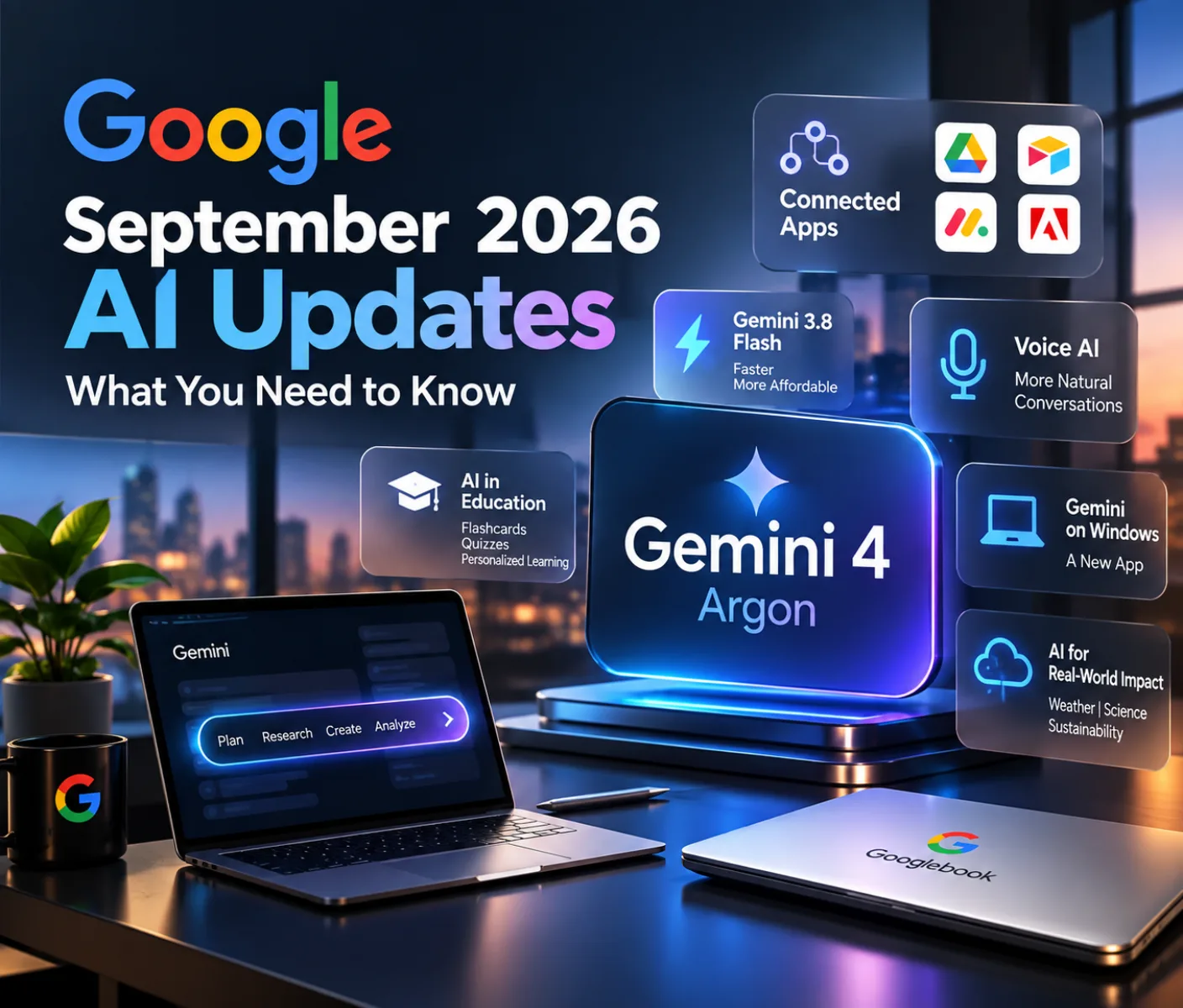

Google’s September 2026 AI updates introduced major changes across Gemini, AI-powered workflows, connected apps, education, and productivity. From the launch of Gemini 4 Argon to new ways of using AI across everyday tasks, these updates show how quickly Google’s AI ecosystem is evolving. But what do these changes mean for businesses and everyday users? Let’s break it down.
Gemini 4 Argon is Google’s new AI model. It’s designed for complex tasks and workflows. Google describes it as a game-changer for software engineering, business tasks, and cybersecurity.
Before Argon, the token limit was just 64K. Why is this important? Well, some tasks need more than a short answer. They require the AI to work through a lot of details. Things like:
By using Argon, you can give it a bigger problem to tackle. It’s not just about asking one small question anymore.
Long-horizon tasks are becoming essential. Instead of a simple prompt and answer, think of it as:
• Goal
• Planning
• Research
• Execution
Google says Argon is built for these workflows. It can keep track of many steps, making it more effective for real-world tasks. It scored 77.9% on important benchmarks. But remember, these are tests by Google, not guarantees for every business task.
Gemini 3.8 Flash is another important launch. This model is faster and more cost-effective. Google aims this at everyday tasks. Think of things like:
This model is available for just $0.75 per million input tokens. For businesses running multiple small tasks, cost and speed matter a lot!
One of the most practical updates is the expanded Connected Apps feature. Now you can link Gemini with tools like Airtable, monday.com, and even Adobe. Why is this cool?
• Less switching between apps
• More streamlined workflows
Imagine asking Gemini to help you research, and then it turns that info into a document automatically. This is a new level of AI workspace!
Google introduced voice-focused models like Gemini 3.8 Live. These allow for more natural conversations with AI. This is great for times when typing isn’t convenient.
New tools in Gemini Notebook support learning. Features like flashcards and quizzes help students study better. Instead of just asking, “Explain this topic,” students can turn study material into:
Google expanded its personal agent, CC, into a group assistant. This helps with household logistics, sharing schedules, and managing tasks. This shows that AI can do more than just assist one person; it can coordinate a whole group.
Google launched the Gemini app for Windows. Now, you can quickly access its features without opening a browser. This can make working with AI much more natural.
Google announced Googlebook, a laptop designed around AI features. It includes tools like Magic Pointer, which lets users ask Gemini questions just by pointing!
Google also highlighted AI applications in science. For instance, WeatherNext 3 tracks weather patterns very precisely. Other projects include studying genetics and mapping methane emissions from space.
These updates show Google is building an AI ecosystem. It’s no longer just about choosing the right model but asking how to improve workflows. For businesses, this is vital.
Instead of merely saying, “I need an AI tool for marketing,” consider breaking down your workflow:
• Research
• Strategy
• Creation
• Execution
• Analysis
The focus is shifting from using specific tools to integrating AI into entire workflows. This can allow more time for strategy and creativity.
The announcements from September show a clear direction. AI is becoming:
For professionals, it’s about finding which parts of your workflow can be improved through AI. This is where the true potential lies. Ask yourself: What part of your daily workflow would you hand over to an AI agent first?
Gemini 4 Argon is Google’s latest AI model designed for complex tasks across various industries.
Gemini connects with other applications, allowing for smoother transitions and task execution.
Yes! Gemini offers tools like flashcards and quizzes that help students study more effectively.
Gemini 3.8 Flash is priced at $0.75 per million input tokens and $3.75 per million output tokens.


Partner with a digital marketing expert to drive growth, enhance visibility, and achieve your business goals seamlessly.






Driving growth through innovative digital strategies for clients and shaping the future of marketing by mentoring the next generation.
© Copyright 2026 Mohsin Qasim – All Rights Reserved.